
Written and Compiled by: Engineer Rashid Ahmed
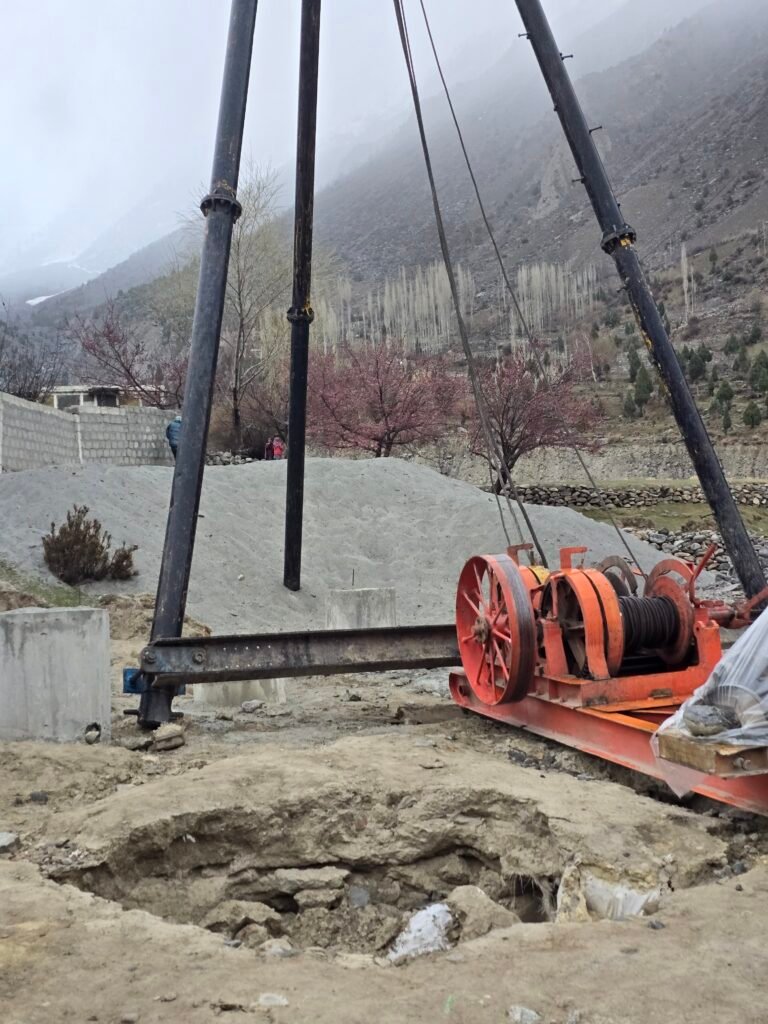
The progress of a society cannot be measured merely by the number of new buildings constructed, the roads developed, or the expansion of residential and commercial areas. True development is one in which the protection of human life, property, the environment, and future generations remains a fundamental priority alongside construction and economic growth.
Unfortunately, across different parts of Pakistan, and particularly in Gilgit-Baltistan, the rapid expansion of private-sector construction is increasingly accompanied by a concerning practice: some buildings are being initiated or completed without appropriate engineering designs, approved plans, applicable building regulations, qualified engineers, or professional consultancy services.
This is not merely a matter of violating a drawing or obtaining a permit.
It is a matter of protecting human life.
Gilgit-Baltistan is a mountainous region exposed to hazards including earthquakes, landslides, intense rainfall, flash floods, river flooding, and Glacial Lake Outburst Floods (GLOFs). In such an environment, unscientific and unprofessional construction practices can lay the foundation for a major disaster in the future. Relevant documents of the National Disaster Management Authority (NDMA) also identify various districts of Gilgit-Baltistan as vulnerable to multiple natural hazards and emphasize the need for safe and resilient infrastructure.
The Problem Is Not Merely the Building; It Is the Construction System
We must understand that a building is not simply an assembly of bricks, stone, cement, and steel. A safe building is the product of proper site assessment, structural engineering, compliance with building regulations, quality materials, sound workmanship, technical supervision, and systematic inspection.
Where and how deep should the foundation be?
What is the bearing capacity of the soil?
What should be the size and arrangement of columns and beams?
What should be the quantity and detailing of reinforcement steel?
What should be the quality of concrete?
How will the building respond to earthquake forces?
How will rainwater and floodwater be safely drained?
How safe is the site from landslides or flood channels?
These decisions cannot be left merely to the experience of a mason, the discretion of a contractor, or the assumptions of a property owner. They require appropriate professional expertise and engineering judgment.
The Building Code of Pakistan 2021, developed under the Pakistan Engineering Council, establishes minimum safety requirements for buildings and structural works and provides an administrative framework addressing the responsibilities of authorities, enforcement bodies, design professionals, contractors, and property owners.
Why Is Greater Caution Necessary in Gilgit-Baltistan- the upper indus regions?
The geographical characteristics of Gilgit-Baltistan distinguish it from ordinary urban environments. The region contains steep mountain slopes, streams, rivers, glaciers, glacial lakes, and narrow valleys. Consequently, inappropriate construction at one location may not merely create a problem for an individual house; it can create risks for an entire community.
A house constructed in the wrong location may obstruct a natural flood route.
A weak retaining wall may destabilize an entire slope.
An inadequate foundation may seriously compromise a building’s performance during an earthquake.
Substandard construction materials may appear satisfactory under normal conditions but reveal their weaknesses during a severe natural disaster.
Therefore, in Gilgit-Baltistan, it is dangerous to consider “the building has been constructed” synonymous with “the building is safe.”
The Need for a Comprehensive Construction Policy
It is now time for the Government of Gilgit-Baltistan to stop treating construction merely as a matter of municipal permissions and recognize it as an integral component of Public Safety and Disaster Risk Reduction.
The National Disaster Risk Reduction Strategy 2025–2030 also emphasizes preparedness, resilient infrastructure, effective governance, and the use of technology to reduce the impact of natural hazards.
Therefore, Gilgit-Baltistan should develop a comprehensive Safe and Resilient Construction Policy, applicable equally to both the public and private sectors.
1. Gilgit-Baltistan Building Safety and Control Law
The Government should introduce comprehensive legislation under which:
- Legal approval should be mandatory for every new building;
- Clear requirements should be established for residential, commercial, industrial, educational, healthcare, and government buildings;
- The Building Code of Pakistan and other approved technical standards should be given appropriate legal effect;
- Earthquake, flood, GLOF, landslide, and other local hazards should be incorporated into building design;
- Effective legal action should be taken against construction initiated without approval;
- Unsafe construction should not simply be allowed to continue after payment of a fine;
- Depending on the nature and severity of the violation, authorities should have powers to stop construction, require corrective measures, impose penalties, and, where necessary, order demolition in accordance with law.
The fundamental principle of the law should be clear:
“The right to construct must be accompanied by the responsibility to construct safely.”
2. No Construction Without a Qualified Engineer and Professional Consultant
Except for minor repairs and other specifically exempted works defined by law, new construction should require:
Architectural Design + Structural Design + Site Assessment + Professional Certification
as fundamental components of the approval process.
Property owners should retain the right to select qualified professionals for their projects. However, the Government must ensure that any person whose engineering design is submitted for approval meets the relevant professional standards and legal registration requirements.
The system must establish genuine professional accountability rather than allowing a nominal engineer or a person who merely signs documents without actually undertaking professional responsibility.
3. The Same Standards Must Apply to Government Construction
The most important principle of the law should be equality.
The fundamental safety requirements applicable to a private citizen’s house should also apply to government buildings.
Accordingly, all government departments, development authorities, municipal institutions, public housing schemes, schools, hospitals, bridges, offices, and other public projects should follow a complete:
Design Review → Approval → Site Supervision → Quality Control → Completion Inspection → Occupancy Certificate
process.
No government department should be exempt from essential construction safety requirements merely because a project is publicly funded.
4. Building Permits Must Become Technical Approvals, Not Mere Paperwork
If the building-permit process is limited merely to submitting drawings and paying a fee, it cannot provide adequate protection.
Before approval, an effective system should assess at least:
Site Conditions — Site Risk — Zoning — Flood Risk — Drainage — Road Access — Basic Design — Structural Design — Earthquake Resistance — Fire Safety — Emergency Egress.
For sensitive locations, geotechnical investigations and other technical studies should be required where appropriate.
5. Hazard-Zoning Maps Must Be Linked to Building Permits
Multi-Hazard Zoning Maps should be prepared for every major city and town in Gilgit-Baltistan.
These maps should identify, at a minimum:
- Earthquake hazards;
- Flood-prone areas;
- Streams, drainage channels, and natural watercourses;
- GLOF-prone areas;
- Potential landslide zones;
- Unstable slopes;
- Vulnerable riverbanks;
- Emergency evacuation routes.
The building-permit system should then be integrated with these hazard maps.
In other words, if a location falls within a hazardous zone, it should not be sufficient merely to establish that the landowner has legal ownership. Authorities must also determine what type of construction, if any, is safe and legally permissible at that location.
6. Mandatory Site Inspections at Critical Stages of Construction
Inspection only after completion of a building is not sufficient.
The relevant government or authorized technical authority should have both the power and responsibility to inspect critical stages of construction, including:
Foundation → Reinforcement → Structural Frame → Roof → Services → Final Inspection
Each inspection should become part of a digital record.
If significant deviation from the approved design is detected at any critical stage, permission to proceed to the next stage should be withheld until the matter is properly resolved.
7. No Occupancy Without a Completion Certificate
After construction is completed, a formal Completion / Occupancy Certificate should be issued.
Without such certification, it should be unlawful to:
- Permanently occupy a newly constructed building;
- Commence commercial operations;
- Move government offices into the building;
- Use the building for public gatherings.
The certificate should not be treated as a mere administrative formality. It should confirm that the building has been constructed in accordance with the approved design and that the required inspections have been completed.
8. Structural Safety Audits of Existing Buildings
The problem is not limited to new construction.
Urban areas may contain existing buildings constructed according to outdated standards, buildings that have subsequently undergone unauthorized modifications, or structures whose condition has deteriorated over time.
The Government should therefore introduce, in phases, an:
Existing Building Safety Audit Programme.
Particular attention should be given to:
- Schools;
- Hospitals;
- Government offices;
- Markets;
- Hotels;
- Public assembly buildings;
- High-rise buildings;
- Buildings located near rivers or streams;
- Buildings situated on vulnerable slopes.
These structures should undergo appropriate technical safety assessments.
9. Three-Tier Enforcement Against Illegal Construction
A fine alone is not sufficient to eliminate unsafe or illegal construction.
An effective enforcement mechanism should have three levels:
Level One: Notice and Correction
The violation is identified, construction is stopped where appropriate, and the owner is given a specified period to correct the deficiency.
Level Two: Penalty and Stop-Work Order
In cases of serious violations, substantial penalties should be imposed and construction activity suspended.
Level Three: Demolition or Legal Action
Where a structure presents a serious threat to human life or involves an irreparable violation, the law should provide for demolition or other appropriate legal action.
At the same time, the entire system must guarantee a transparent right of appeal, written reasons for decisions, and due process, so that enforcement powers do not become instruments of arbitrary action.
10. Professional Responsibility of Engineers, Consultants and Contractors
It would also be inappropriate to place responsibility solely on property owners.
If an engineer, consultant, or contractor deliberately deviates from an approved design, uses substandard materials, issues a fraudulent certificate, or approves construction that clearly fails to meet safety standards, appropriate professional and legal action should follow.
Likewise, a system should be established to hold accountable anyone who issues certificates merely for a fee without conducting the required inspections or assuming genuine professional responsibility.
11. Construction Material Quality Control
Design alone is not sufficient; substandard materials can undermine the entire engineering system.
The Government should establish a formal system for quality assurance of construction materials, including, where necessary:
Concrete Testing, Steel Testing, Material Certification, and Site Quality Records.
For major projects, independent third-party testing may be made mandatory.
12. Digital Building Control System
Gilgit-Baltistan should progressively establish a Digital Building Control System.
Each building should receive a unique Building Identification Number, linked to:
- Basic ownership information;
- Approved architectural plans;
- Structural drawings;
- Details of the relevant engineer/consultant;
- Building permit;
- Inspection reports;
- Completion certificate;
- Subsequent structural alterations.
This would improve transparency and make it possible to determine, in the future, on what basis a building was approved and whether the required standards were followed during construction.
13. An Empowered Building Control and Safety Authority
When responsibility is divided among multiple departments without effective coordination, enforcement can become weak.
The Government should therefore consider establishing a centralized or effectively integrated:
Gilgit-Baltistan Building Control & Safety Authority
or substantially strengthening and reorganizing the existing institutional framework.
The authority should have technical capacity in at least:
Structural Engineering, Architecture, Town Planning, Geotechnical Engineering, Disaster Risk Reduction, Fire Safety, Environmental Planning, and Building Inspection.
It should work in coordination with relevant municipal and district authorities.
14. Public Complaints and Whistleblower Mechanism
If a citizen observes illegal construction at a hazardous location, an accessible and secure mechanism should be available for reporting it.
An:
Online Complaint Portal + Mobile App + Helpline
could be established through which citizens may submit photographs, location information, and basic details of the suspected violation.
The status of action taken on complaints should also be made available online.
The purpose of such a system should not be to harass individuals, but to identify and stop dangerous construction at an early stage.
15. The Private Sector Should Be Made a Partner, Not Treated as an Adversary
The purpose of construction regulations should not be to stop development, but to make development safe.
The Government should therefore bring engineers, architects, consultants, contractors, developers, property owners, chambers of commerce and industry, local governments, and universities into a common stakeholder framework.
Clear registration requirements, professional standards, and accountability mechanisms should be established for qualified private consulting and engineering firms.
In this way, the private sector can become not a burden on the government system, but a partner in a Safe Construction Programme.
16. A Safe Construction Checklist for the General Public
The Government should launch public-awareness campaigns in every district.
Every person planning to construct a house should ask at least these seven questions:
1. Is my land suitable and safe for construction?
2. Is my site located near a flood path, stream, river, or hazardous slope?
3. Is my building plan properly approved?
4. Has the structural design been prepared by a qualified engineer?
5. Is construction being carried out according to the approved design?
6. Are the critical stages of construction being technically inspected?
7. Will a Completion / Occupancy Certificate be obtained after completion?
If the answers to these questions are unclear, construction should be paused and appropriate professional advice obtained before proceeding.
17. Engineering and Disaster Management Must Be Integrated
Construction planning and disaster management can no longer be treated as separate fields.
Recent activities of the National Disaster Management Authority have emphasized monitoring flood, landslide, and GLOF risks in Gilgit-Baltistan, along with early warning and local preparedness.
Therefore, permanent institutional coordination should be established between the building control and safety authority and the Gilgit-Baltistan Disaster Management Authority (GBDMA).
In every district, construction planning should be integrated with locally relevant hazard information.
18. Five-Year “Safe Gilgit-Baltistan Construction Programme”
This policy should not end with the enactment of legislation. It should be implemented through a clear five-year programme.
Year One
Legislation, institutional reforms, hazard mapping, and a review of existing laws.
Year Two
Digital building-permit system, professional registration, and district-level inspection mechanisms.
Year Three
Structural safety audits of existing sensitive government and public buildings.
Year Four
Correction, strengthening, and, where necessary, relocation of unsafe buildings.
Year Five
Independent performance evaluation of the entire system and necessary reforms to legislation and policy.
Every year, the Government should publish a Building Safety Report containing aggregate data on approved projects, inspections, violations, and corrective actions.
The Final Question: Why Wait for a Disaster?
The fundamental principle of disaster risk reduction worldwide is that societies should not rely solely on emergency response and reconstruction after a disaster. Risks must be reduced before a disaster occurs.
At the national level, Pakistan is also increasingly emphasizing disaster risk reduction, resilience, and proactive planning.
It is time to translate this approach into practical action within the construction sector of Gilgit-Baltistan.
We must ask ourselves:
Do we merely want to construct buildings, or do we want to construct safe buildings?
Do we merely want cities and roads to expand, or do we want cities that are safer and more resilient in the face of earthquakes, floods, and other natural hazards?
Will we prepare only to remove the rubble after a disaster, or will we act today to prevent unsafe structures from becoming rubble tomorrow?
These questions are not directed at the Government alone. They concern every citizen, engineer, architect, consultant, contractor, and developer.
The weakness of a building’s foundation may not be visible today, but at the moment of a natural disaster, that same weakness can become the difference between life and death.
Therefore, safe construction in Gilgit-Baltistan must not be treated merely as an administrative matter. It must be recognized as a fundamental component of public safety, human security, urban planning, and disaster risk reduction.
The Government must enact effective laws. Institutions must enforce them. Professionals must fulfill their responsibilities. Citizens must also understand that spending on engineering expertise is not an unnecessary burden; it is the price of protecting their lives, their families, and future generations.
Development is not merely about putting up buildings;
development is about building while keeping people safe.
And in a sensitive region such as Gilgit-Baltistan, the guiding principle of construction should now be clear: